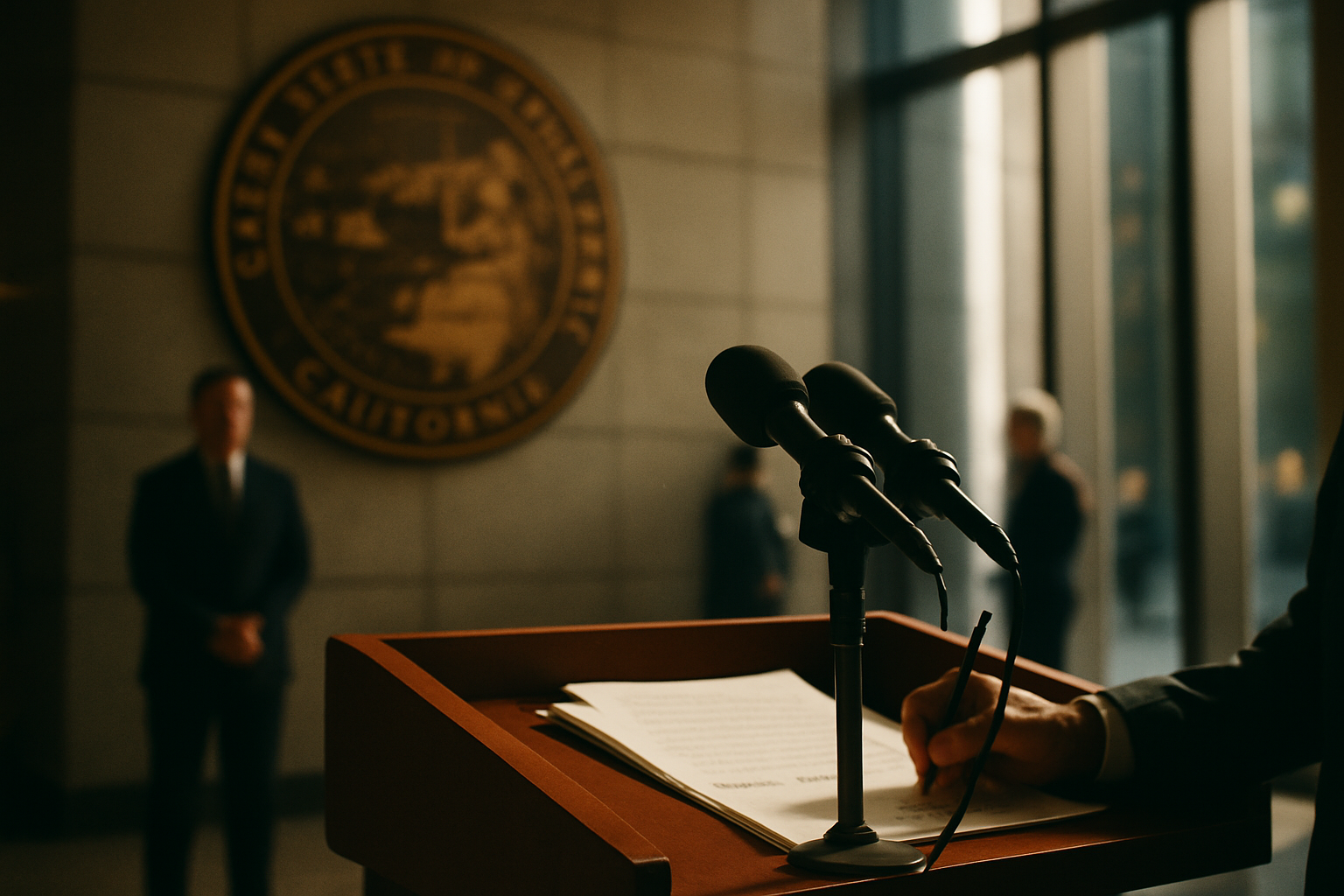
On March 30, 2026, California Governor Gavin Newsom signed an executive order requiring AI companies contracting with the state to implement safety guardrails, privacy protections, and watermarking for AI-generated content, according to an official announcement from the Governor's office. The first order of its kind in the United States — and great news for companies that are serious about AI.
Mandatory watermarking: a filter, not a punishment
The key provision: the California Department of Technology must develop recommendations for mandatory watermarking of AI-generated images and videos. Every visual produced by a model will need to be identifiable as such.
Important: the executive order specifically targets AI-generated images and videos — not text. Articles, descriptions, and AI-assisted text content are not subject to this watermarking requirement.
For companies already using AI transparently and professionally, this changes nothing about their practice — it validates it. This order targets those using AI covertly, those passing their content off as something it isn't. Watermarking isn't a brake on innovation: it's a natural filter that will eliminate bad actors and reward those doing AI right.
The order also requires AI vendors to demonstrate policies against exploitation of illicit content, algorithmic bias, and civil rights violations. Every company bidding for a state contract must prove its safeguards — not just declare them.
AI regulation is coming everywhere — the first movers win
California is the world's 4th largest economy. Its tech regulations have a documented domino effect: CCPA inspired laws in 15 US states. The EU AI Act shares the same mandatory transparency philosophy.
OpenAI, Google, Anthropic, and Meta are all California-based. Their tools will need to comply. And what's required for government contracts often becomes the market standard — companies that anticipate this shift today will have a decisive advantage when everyone else is forced to catch up.
For businesses targeting international markets — or simply using American AI tools — this order isn't a distant event. It's a clear signal: professionalizing AI in content is no longer optional.
Key takeaway: AI watermarking won't stay optional for long. Companies that embrace transparency early don't just comply with regulation — they turn it into a competitive weapon.
The real question: how to use AI better than your competitors?
In 2026, the question is no longer whether AI belongs in your content strategy. It already does. The real question is: who's going to use it best?
This executive order shifts the rules in the right direction. It forces a professionalization of AI content production. Brands that produce quality AI content — SEO-optimized, grounded in real expertise, transparently owned — will massively differentiate themselves from those churning out valueless volume.
The March 2026 Core Update is already sending this signal: Google doesn't penalize AI — it penalizes the absence of expertise and added value. AI and E-E-A-T signals aren't opposites. Done right, AI amplifies them.
What to do right now
- Own your AI usage. Document your process, adopt a transparency charter. Brands that play this card before regulation forces them to earn credibility — with users and search engines alike.
- Bet on AI quality, not quantity. A structured, optimized AI content piece with real added value outperforms any mediocre content every time. AI isn't a shortcut — it's an accelerator for those who know how to use it.
- Build your AI + SEO strategy now. AI content + editorial expertise + SEO/GEO optimization: that's the combination that creates lasting visibility on Google and AI search engines alike.
Our take
This order doesn't slow AI in content. It puts an end to AI content pretending to be something else. That's exactly what Google and AI search engines are working to eliminate. For serious players, this marks the beginning of an era where quality wins over opacity.
Companies integrating AI into their content strategy now — transparently, structurally, with a value-first mindset — will be the big winners of the next regulatory wave. Everyone else will be playing catch-up.
Sources
- → California Governor's Office — Official executive order announcement (March 30, 2026)
- → New York Times — Analysis of California's AI executive order
- → CNET — Coverage of safety and privacy requirements

Growth and SEO content strategist, I founded Cicéro to help businesses build lasting organic visibility — on Google and in AI-generated answers alike. Every piece of content we produce is designed to convert, not just to exist.
LinkedIn